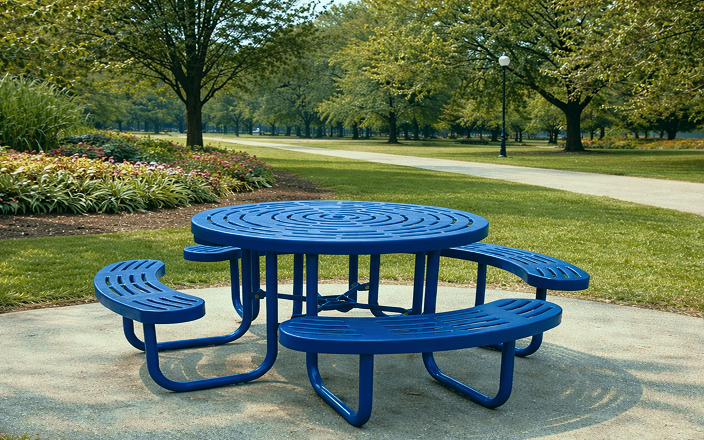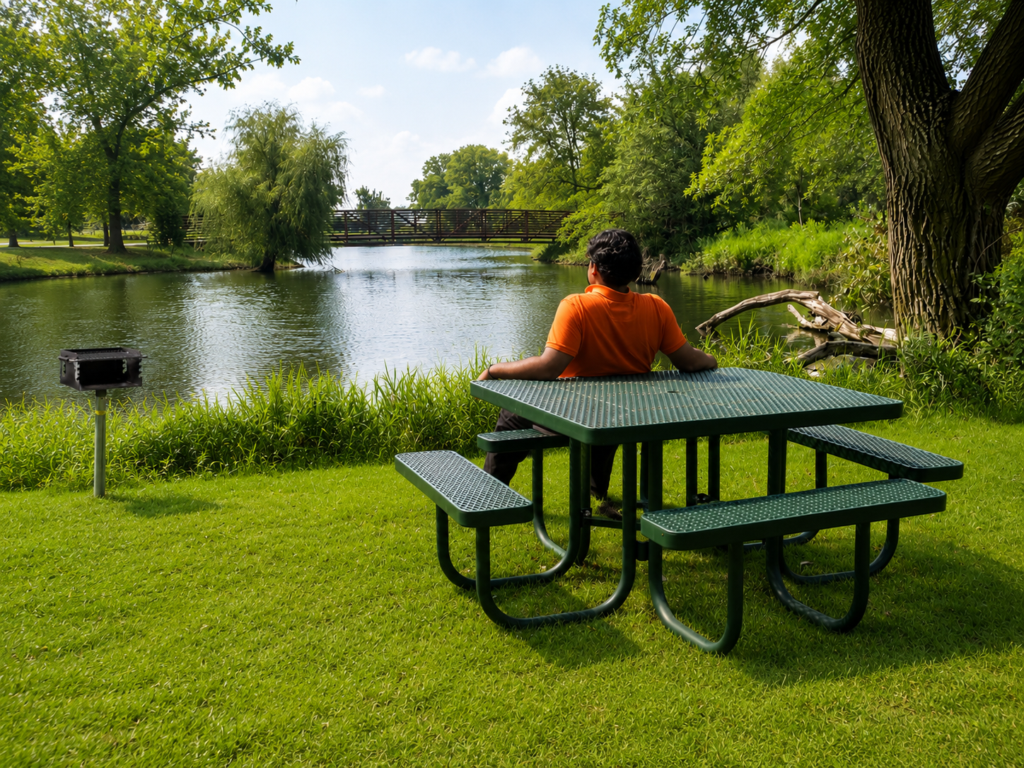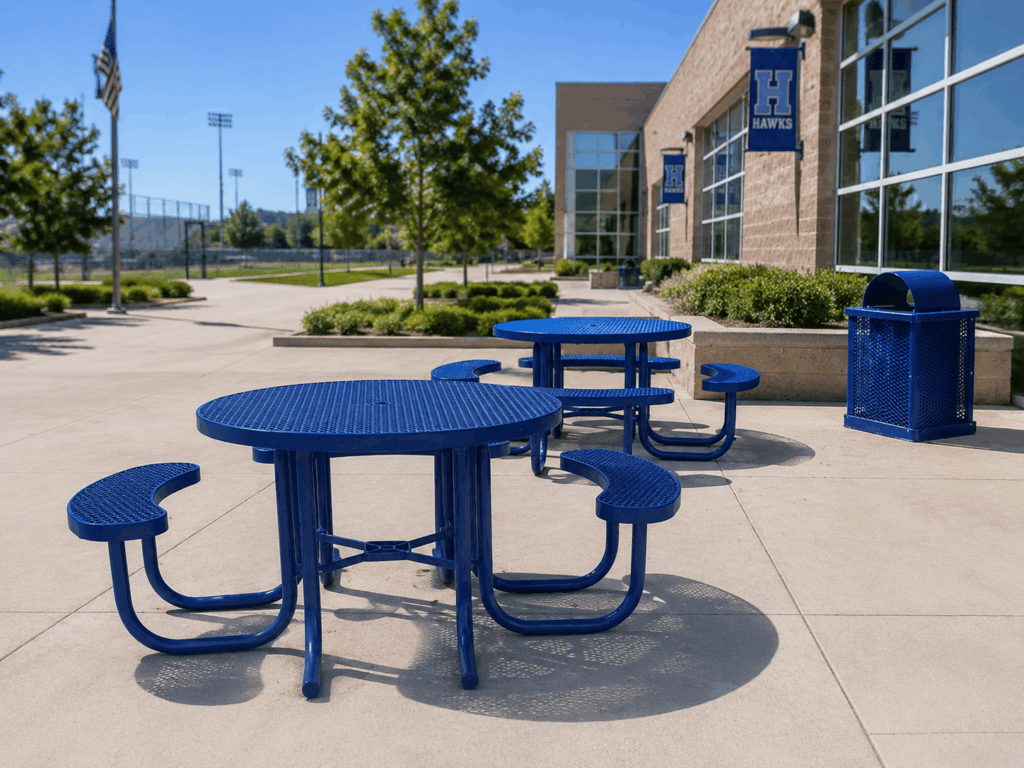
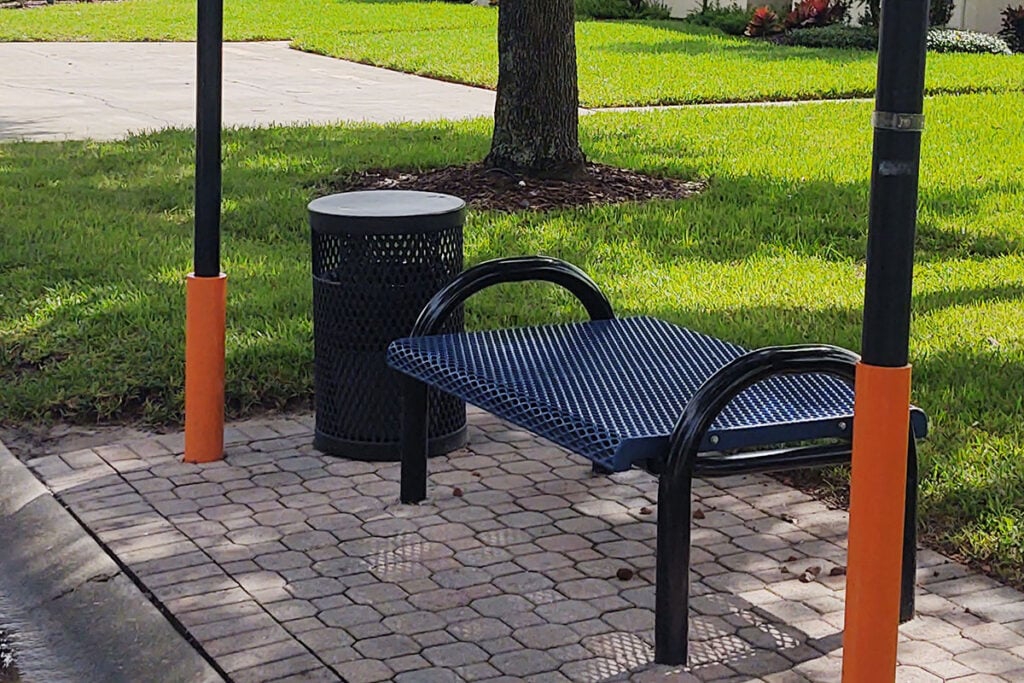
A park gets judged by its worst trash can, not its best table. Visitors notice the overflowing bin, the rack streaking orange rust down its post, the receptacle that tipped over in the last storm and scattered a weekend’s worth of litter across the lawn. The seating can be flawless, but if the amenities around it look neglected, the whole space reads as neglected.
That is why the amenities around the seating are not an afterthought in park design. Trash receptacles and bike racks are what keep a space clean, orderly, and usable every day between the grand-opening photo and the twenty-year mark. At Premier Polysteel, we build our receptacles and bike racks from the same plastisol (polyvinyl) coated steel as our tables and benches, so the pieces doing the unglamorous work hold up exactly as long as the furniture people actually sit at.
Good park design accounts for every piece of park equipment that makes a space function: receptacles for trash and recycling, bike racks, and the mounting hardware that keeps everything in place. This guide covers how to size and place commercial trash receptacles, how to choose bike racks that protect the bikes locked to them, and why specifying every furnishing in matching plastisol-coated steel keeps a site looking intentional for decades.
Why Amenities Make or Break Park Design
Cleanliness in a public space is mostly a function of whether the infrastructure makes the right behavior easy. When a receptacle sits where people finish their food and near every exit, waste ends up in the bin. When it does not, it ends up on the ground. The same logic applies to bikes: put racks near entrances and people use them, leave them out and cyclists lock to benches, railings, and young trees instead.
The failure most sites never plan for is the amenity itself breaking down. A receptacle that rusts through at the base leaks and stains the pad beneath it. A lightweight can blows over and empties across the grass. A rusted bike rack looks abandoned and gets used like it. Premier Polysteel receptacles are built on commercial-grade steel with a plastisol coating bonded over every surface, so there is no exposed metal to rust, and they are heavy enough that wind and casual tampering do not move them.
That durability is what lets an amenity keep doing its quiet job. A clean, intact receptacle signals a maintained space, and a maintained space stays cleaner. The amenities are the unsung heroes precisely because nobody notices them until they fail.
How to Choose Commercial Trash Receptacles
Premier Polysteel commercial trash receptacles come in four capacities, from 11 to 55 gallon, in both round and square styles. The practical approach to sizing is straightforward: put larger-capacity units where traffic and food concentrate, and place enough of them that no one has to walk far to reach one.
| Capacity | Styles offered |
|---|---|
| 11 gallon | Round |
| 22 gallon | Round |
| 32 gallon | Round or square |
| 55 gallon | Round or square |
The lid matters as much as the capacity. Our receptacles come with flat, arch, or dome lids. A flat lid suits covered or simple installations, an arch lid sheds rain in open-air settings, and a self-closing dome lid fully covers the opening to keep weather out and discourage oversized dumping. Each unit uses a rigid inner liner that lifts out for servicing, and our commercial recycling receptacles share the same coated-steel construction with openings configured to keep streams separated. The full range is on our commercial trash receptacles page.
Every receptacle is offered in a range of UV-stable color options, and because the color is mixed through the full thickness of the plastisol rather than painted on, a scuff never reveals bare metal or a different shade underneath. That is the difference between a receptacle that still looks new after two decades and one that starts showing its age after two winters, a gap we cover in depth in our guide to long-lasting outdoor receptacles.
How to Choose Commercial Bike Racks
Bike racks succeed or fail on two things: whether they hold a bike securely and whether they damage it. Premier Polysteel commercial bike racks come in loop, t-post, and gate styles, so you can match capacity to the site. Loop racks run five lengths, from a single loop that holds three bikes up to a five-loop that holds eleven. The t-post style parks two bikes in a compact footprint, and the two-sided gate style handles eight or twelve bikes for high-demand entrances.
Here is the detail most specifications miss. On bare or powder-coated steel, a locked bike leaning against the rack grinds paint off its own frame, and every scratch on the rack itself starts rusting. Our plastisol coating is thick and slightly yielding, so a frame resting against it does not get scratched, and because the steel underneath is never exposed, the rack does not rust where bikes rub it hour after hour. For a campus planner or parks director, that means racks that still look intentional years later and riders who are not complaining about scraped frames.
Racks also need to stay put. Depending on the style, they install free standing, surface mounted, or in ground, because a rack that can be lifted and carried off is a theft risk and a liability. Anchoring is part of the spec, not an accessory.
The Matched-System Advantage
Here is the argument that separates a coordinated site from a patchwork one. Most sites are assembled from whatever each category’s low bidder supplied: a powder-coated receptacle here, a recycled-plastic bench there, a bare-metal rack by the entrance. Each material ages on its own schedule. Five years in, the powder coat is chipping, the plastic has faded unevenly, the rack is rusting, and nothing matches anymore. Replacing one piece only makes the mismatch worse, because the new unit does not weather like its neighbors.
Specify your park furniture in one system, Premier Polysteel plastisol-coated steel, and that problem disappears. The receptacles, bike racks, tables, and benches share one coating, one color line, and one industry-leading 20-year warranty on the products we manufacture. They age as a set because they are the same material, from one American manufacturer in Northwood, Iowa, on one four-week lead time. The site you photograph on opening day is the site you still have two decades later, with no repainting or refinishing along the way.
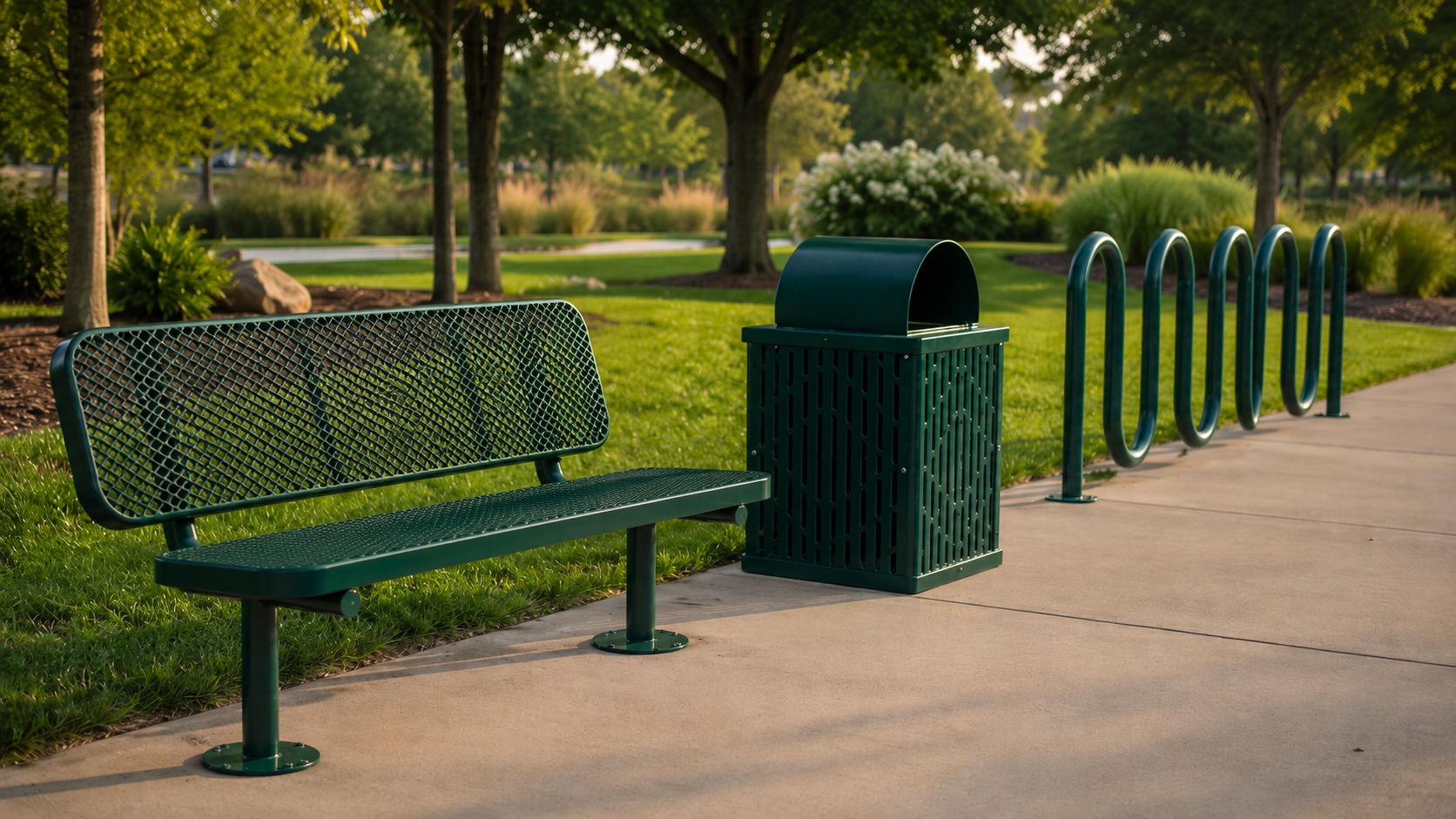
Anchoring and Placement Done Right
Where and how an amenity is fixed to the ground decides whether it stays useful. Premier Polysteel receptacles anchor with either surface mount or in ground kits, depending on the surface and the site. Surface mounting bolts a unit to an existing concrete pad; in ground mounting sets it into the ground for a permanent, tamper-resistant installation.
Placement is the other half. Put receptacles where waste is generated and where people leave: beside picnic tables, at trailheads, and at every exit. Put bike racks near building entrances and destinations, close enough that locking up is easier than not. Amenities that are anchored and well-placed do their job invisibly, which is exactly the point.
Frequently Asked Questions
How many commercial trash receptacles does a park need?
There is no fixed ratio, but the reliable rule is to pair receptacles with the spots that generate waste and mark exits. Every picnic area, playground, sports field, and park entrance should have one within easy reach, sized to that spot’s traffic.
What size commercial trash receptacle is best for a park?
Premier Polysteel offers 11, 22, 32, and 55 gallon receptacles. As a general rule, match larger capacities to higher-traffic areas: the 32 and 55 gallon units handle playgrounds, fields, and event spaces, while 11 and 22 gallon units fit lower-traffic spots.
Do commercial bike racks need to be anchored?
Yes. An unanchored rack can be lifted and carried off, which defeats its purpose and creates a liability. Premier Polysteel bike racks install free standing, surface mounted, or in ground depending on the style, so they stay fixed and secure.
Will a metal bike rack scratch bike frames?
Bare and powder-coated racks can, and they rust where the finish is worn. Premier Polysteel racks are coated in thick plastisol that will not scratch a frame resting against it and never exposes bare metal to rust.
Complete Your Site Plan
In park design, the tables get the attention. The receptacles and bike racks are what keep the space clean, secure, and cohesive long after opening day, and they only work if they are built to last as long as everything around them.
Specify them as one system and the whole site ages together. Request a quote or spec package to coordinate your commercial trash receptacles, recycling receptacles, and bike racks in matching plastisol-coated steel.